
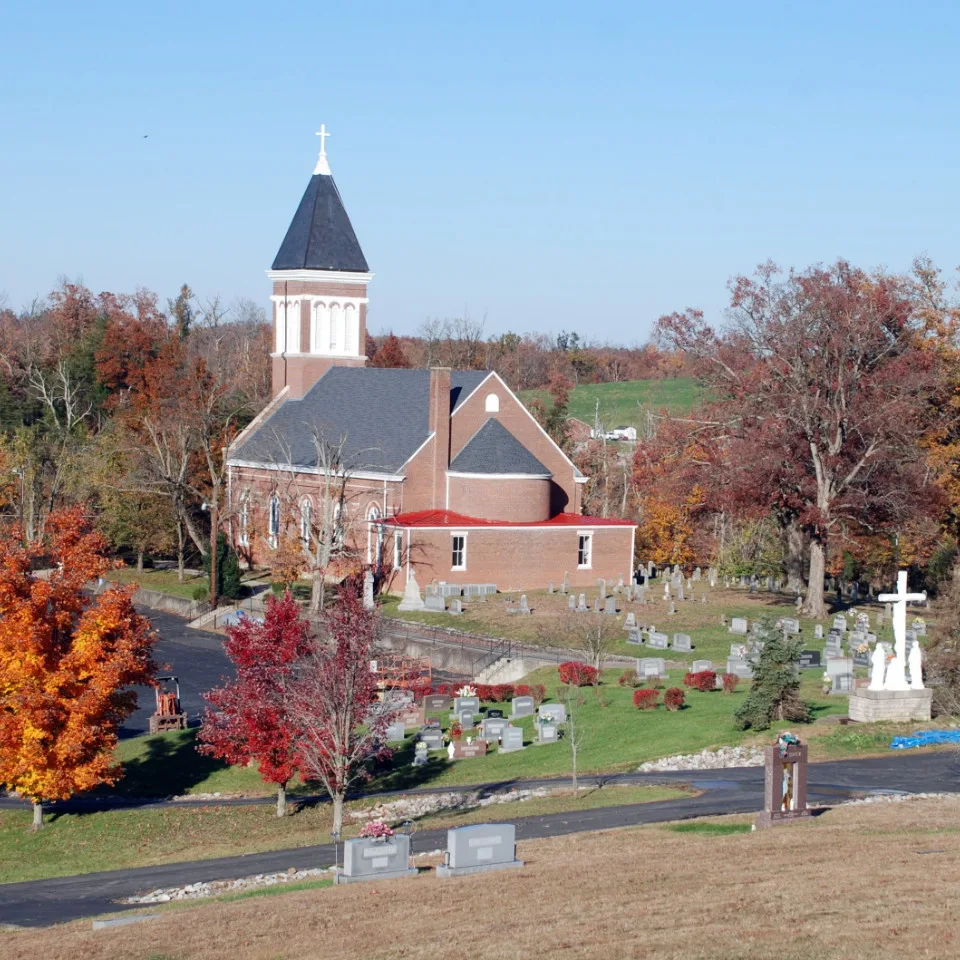
Not every Kentucky church wears its story on its sleeve. Some live quietly in the folds of family memory and the patina of old wood, where whispers of monks, French kings, and faithful farmers still echo between the pews.
This is the story of St. Vincent de Paul Church in New Hope — a church raised not just by hands, but by hearts. From an altar carved across the sea to a schoolhouse run by nuns and casseroles, this parish has been a cradle of frontier faith for over 200 years.
Foundations of Faith: The First Families of New Hope
Before there was a town called New Hope, there was James “John Baptist” Dant. A devout Catholic from Maryland, Dant brought his family to Kentucky’s Rolling Fork area around 1793. In 1800, he opened his own log cabin to the Mass. Dant wasn’t alone. Other early Catholic families followed: the Heads, Browns, Vowels, Miles, and Mastersons.
In 1819, under the guidance of missionary priest Fr. Charles Nerinckx, a small log chapel was erected on or near the Dant property and formally named St. Vincent de Paul.
By 1887, they broke ground for the church that still stands today. At the heart of that effort was Edward Leo “E.L.” Miles, a prominent distiller whose Belle of Nelson distillery had brought prosperity to New Hope. Miles and his wife Annabelle donated land for the church and gave $11,000, more than half of the total building cost.
One local put it best: “The whiskey might’ve put New Hope on the map, but it was the church that gave us a soul.”
The Altar from Across the Sea: Craft and Lore
Step inside St. Vincent de Paul today and you’ll see it — a hand-carved wooden altar, deep-toned oak, rich with gilded accents and gothic lines. Parish records confirm the altar and lectern were shipped from France by boat sometime around 1887-1888.
Some say the altar once stood in a French chapel used by exiled royalty, possibly even connected to King Louis-Philippe. One family insists their grandmother claimed the altar “came from a castle.”
The Abbey Next Door: Gethsemani’s Quiet Influence
Just a few miles away sits another sacred site: The Abbey of Gethsemani, home of the Trappist monks and made famous by Thomas Merton. St. Vincent’s founder, James Dant, donated the land where the monks settled in 1848.
The School Beside the Sanctuary
In 1890, the Sisters of Charity of Nazareth began teaching at St. Vincent’s School. During the Great Depression, the school temporarily operated as a public school from 1934 to 1945.
Lore, Laughter, and a Living Legacy
In the 1920s, the church basement doubled as a roller-skating rink during summer socials. One story claims a squirrel ran across the rafters during a High Mass. Others recall cooking dinner with whiskey gravy for fundraising dinners.
About the Author

Kenny Browning is a lifelong resident of Marion County, Kentucky, with over 72 years of deep roots in the community. A passionate storyteller and history enthusiast, Kenny offers personalized tours that highlight the beauty and history of rural Kentucky.