
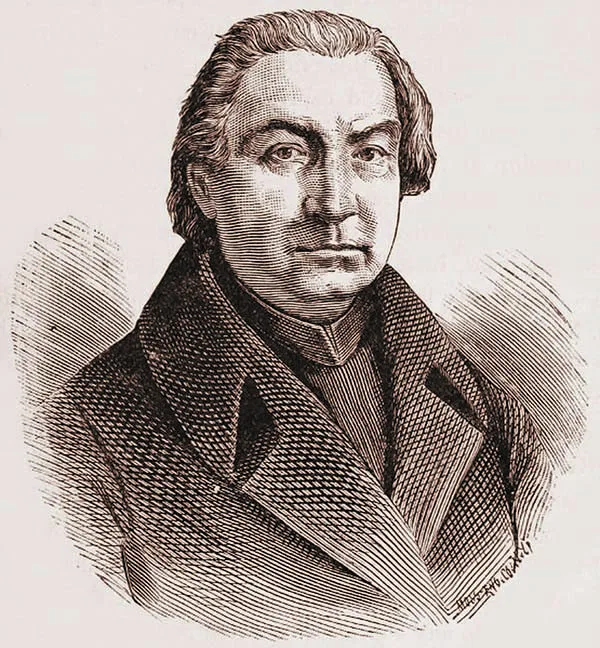
Father Charles Nerinckx – Apostle of Kentucky
Not every saint has a statue, and not every hero wore a sword. Some just had a Bible, a battered horse, and more grit than most men could muster. That’s the kind of man Father Charles Nerinckx was. You won’t find him on currency or in a war memorial, but if you grew up Catholic in Kentucky—or anywhere touched by the Loretto Sisters—you’re standing in the shadow of what he built.
A Start in the Old World
Charles Nerinckx was born on October 2, 1761, in the small Flemish village of Herfelingen, Belgium. The eldest of fourteen children, he grew up in a devout Catholic family. His father, a respected physician, wanted the best for him, and his mother laid a foundation of deep faith that would guide him for life. Young Charles was serious and thoughtful, and by the time he was a teenager, his heart was already drawn to the Church.
He studied theology at Leuven, one of Europe’s oldest Catholic universities, then entered the seminary at Mechelen. At just 24, he was ordained a priest and assigned to a rural parish near Leuven. He didn’t just take up a pulpit—he rolled up his sleeves. The church was falling down. The faith of the people was in worse shape. So Nerinckx started with what he had: he repaired the chapel, started catechism classes for children, and visited every home he could. By the time he left, his parish was thriving. It was a pattern he would repeat, over and over again.
Persecution and Escape
But the French Revolution didn’t care about thriving churches. In 1797, the revolutionary army rolled into Belgium and brought with it a wave of anti-clerical laws. Churches were seized, priests arrested, and the Catholic faith driven underground. Father Nerinckx refused to take the loyalty oath that would have made him a servant of the state. Instead, he went into hiding.
For nearly seven years, he lived on the run. At one point, he was sheltered by nuns in a hospital chapel, where he disguised himself and said Mass before dawn to avoid detection. Imagine: waking at 2 a.m. to celebrate the Eucharist in whispered Latin, always looking over your shoulder. It would’ve broken a lesser man. But for Father Nerinckx, it deepened his sense of mission.
He couldn’t minister openly in Europe anymore. But across the ocean, in a new country called the United States, the Church was growing—and desperate for priests.
A New Mission in a New Land
In 1804, Father Nerinckx left everything he knew behind and boarded a ship to America. The voyage took 90 stormy days. When he finally arrived in Baltimore, he found himself in a young, hungry Church. Bishop John Carroll—America’s first bishop—sent him to a frontier where Catholic settlers were scattered across hills, forests, and river bottoms. The place was called Kentucky.
In those days, there was only one Catholic priest working the region: Father Stephen Badin. He had been riding alone for years, trying to cover the vast distances between Catholic families. When Nerinckx arrived in 1805, the two men formed a partnership that would become legendary.
They made their base at St. Stephen’s Farm near Holy Cross, where Kentucky’s first chapel had been built back in 1792. From there, they launched one of the most ambitious missionary efforts in American Catholic history.
Riding the Wilderness for Souls
Father Nerinckx didn’t ease into the job. He leapt into it. On horseback, he rode hundreds of miles every month through the wilderness. He carried a portable altar, vestments, and sacramental oils in his saddlebag. He rode through blizzards, floods, and summer heat. When he couldn’t find a place to sleep, he slept under trees. If no food was available, he fasted.
He lived this way for years.
At every place he visited, he didn’t just offer the sacraments—he built. He gathered the locals, helped lay logs for a chapel, and encouraged them to start a school. If the timber needed felling, he swung the axe. He wasn’t above any labor. In fact, people often said he could lift more, walk farther, and eat less than any of the young men in the area.
One favorite story tells of a time he came to a flooded creek while trying to reach a dying man. Rather than turn back, he stacked saddles on his horse, climbed on top, and rode across the swollen stream. The water came up over the horse’s back, but he made it—just in time to offer Last Rites.
Another tale: a local hothead misheard Nerinckx’s broken English in a sermon and thought he’d been insulted. He challenged the priest to a fight on the road. Nerinckx tried to defuse the situation, but when the young man swung at him, the priest grabbed him and pinned him to the ground. “These young buckskins could not handle a Dutchman!” he joked afterward.
By the time he was through, Father Nerinckx had helped establish at least fourteen churches. These weren’t fancy buildings. Most were simple log chapels built by hand, where children learned their prayers and families knelt together under leaking roofs. But they were the seeds of something lasting.
The Sisters of Loretto
If founding churches had been the only thing Father Nerinckx did, that would’ve been enough. But he had another vision—something even more enduring.
He believed the faith wouldn’t survive unless the children were taught, especially the girls, who had the fewest educational opportunities on the frontier. So in 1812, he gathered three young women—Mary Rhodes, Ann Havern, and Christina Stuart—and started what would become the Sisters of Loretto.
They lived in a little log cabin they called “Little Loretto,” and they began teaching as soon as they had benches. Father Nerinckx wrote their religious rule, inspired by European traditions, and guided them with a mixture of strictness and love. He sent them books, rosaries, even seeds to plant a garden. He preached simplicity, sacrifice, and service.
The Sisters opened schools across Kentucky, then Missouri, then farther west. By the 1820s, they had a motherhouse, a network of missions, and dozens of members. The town that grew up around their home would eventually be called Nerinx in Father Nerinckx’s honor.
To this day, their work continues.
Tensions and Transition
But frontier sainthood is rarely smooth. As new priests arrived in Kentucky—some born and raised in America—they didn’t always understand Nerinckx’s European ways. His strict rule for the Loretto Sisters was viewed by some as too harsh. His spiritual expectations, too demanding. One younger priest, Father Guy Chabrat, openly criticized him.
Rather than cause division, Nerinckx stepped back. He resigned his leadership role with the Sisters of Loretto and quietly began planning his next mission.
His eyes turned west again—this time to Missouri.
Final Mission and Last Days
Missouri had recently become a state. It was wild, wide, and nearly priestless. There were settlers, French families, and Native American tribes—all in need of the Church.
Nerinckx sent Loretto Sisters to open a school. Then, in the summer of 1824, he followed. He met with tribal leaders, arranged for young Native girls to attend school, and began laying the groundwork for a new mission. It was a fresh beginning.
But he would not live to see it flourish.
In August, while traveling near Ste. Genevieve, Father Nerinckx fell gravely ill. The exact illness is unknown—likely fever or exhaustion. He was taken in by a Catholic family, who cared for him in his final hours. On August 12, 1824, Father Charles Nerinckx died—far from home, just as he had lived: in service.
He was 63.
Home Again—After Death
Kentucky didn’t forget him. Nine years later, in 1833, his remains were brought back and reburied at the Loretto Motherhouse. In 1910, the Sisters placed a marble monument on his grave—a white cross flanked by angels.
Today, you can still visit that grave. You can walk the same paths he once rode. You can sit in pews of churches he built, or their descendants. And you can see the fruits of what he started: parishes, schools, and a living legacy in the Sisters of Loretto.
Legacy That Lives
Father Charles Nerinckx wasn’t famous in his lifetime. He didn’t publish books or rise through the Church ranks. But he rode the hills of Kentucky with a mission in his soul, and he gave his life—quite literally—for the people he served.
Many of Kentucky’s historic churches trace their roots to him. Many Catholic families today can count him as part of their story. And everywhere the Sisters of Loretto have taught, healed, or prayed, they carry a spark of his fire.
When people ask us why this region—this stretch of rolling farmland between Bardstown and Lebanon—feels so steeped in sacred history, we tell them about Father Nerinckx. We point to the log chapels, the handmade tombstones, and the stories whispered down through generations.
We tell them about the priest who crossed an ocean, rode a thousand trails, and left behind something no flood, no revolution, and no forgetting could wash away.